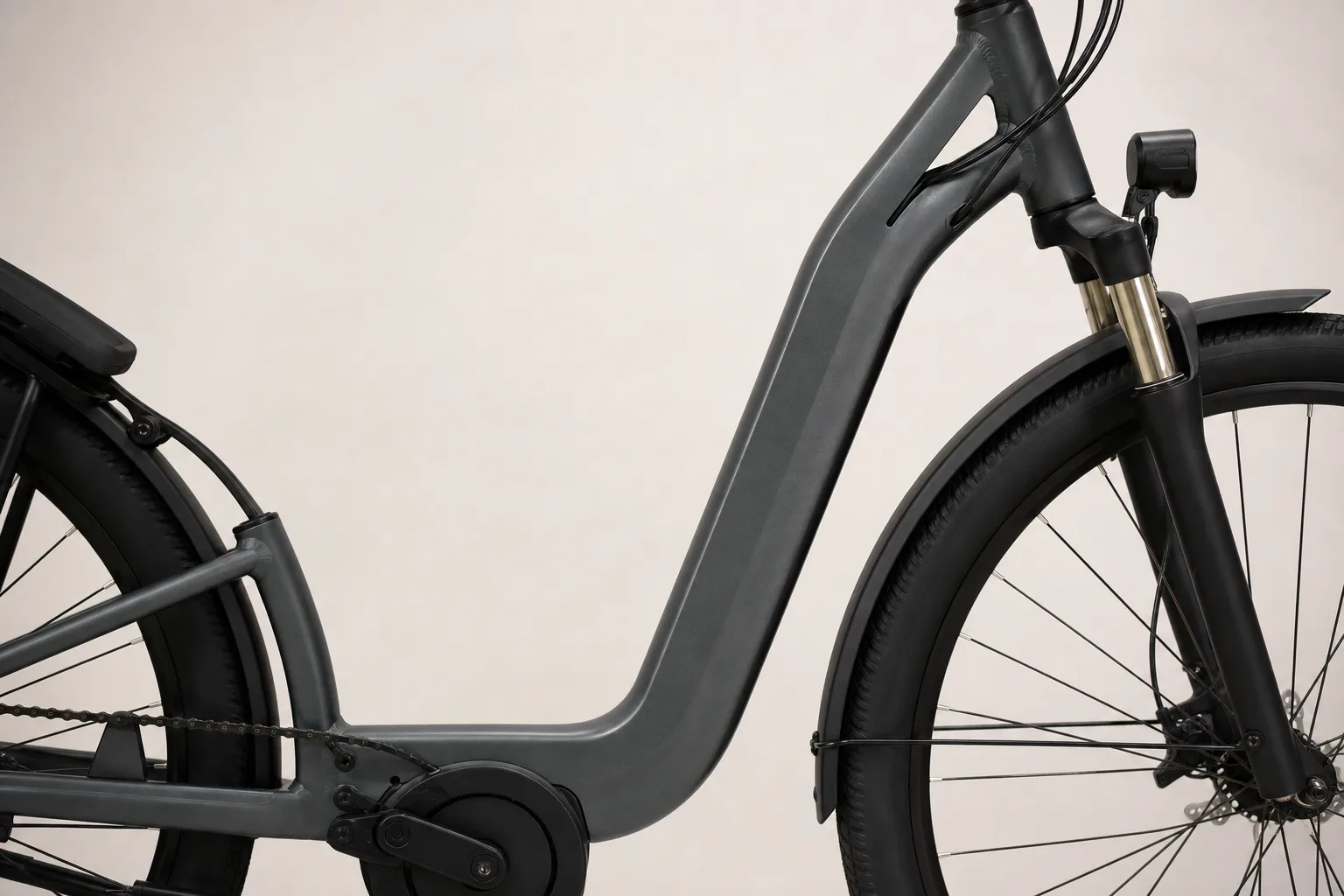
The salesman will tell you a low frame is comfortable, and he is not exactly wrong, but comfort is a by-product rather than the point. What a dropped or absent top tube does is remove the requirement that you lift a leg over the bike at all, and on an electric bicycle weighing somewhere between fifty and seventy pounds with a battery in it, that requirement is a real one. It matters most at the two moments a heavy bike is least stable: getting on, and getting off. Everything else follows from those two moments.
Standover clearance is a measurement, not an adjective
Standover height is the vertical distance from the ground to the top of the frame at the point where you would straddle it, and on a conventional diamond frame it typically sits somewhere near thirty inches, which is roughly the height of a kitchen counter. Straddling a counter is not hard if your hips flex freely. If one hip is stiff from arthritis, a replacement, or an old injury, that clearance becomes the single number that decides whether you ride the bike or leave it in the garage. Look for the figure on the geometry chart, and if the manufacturer does not publish it, measure the bike in the shop with a tape.
Mounting a loaded bike is the test that matters
An empty demo bike on a shop floor tells you very little, because the version you actually ride will have panniers, a rear rack with groceries on it, maybe a child seat, and all of that mass sits high and behind the rear axle where it works hardest against you. Swinging a leg over a loaded rack means clearing not the frame but the cargo, which on a full pannier can add eight or ten inches of height at exactly the wrong place. A low step-over removes that geometry problem entirely: you walk into the bike from the side, plant both feet, and only then think about the pedals. That is why so many delivery riders and grocery-run commuters end up on one.
Stopping in traffic without leaving the saddle
The other half of the argument happens at intersections. On a bike with a high top tube, coming to a stop means sliding forward off the nose of the saddle to reach the ground, and then shifting back up when you go, which is a small athletic act you perform dozens of times on a city ride. With a low frame, you can set the saddle at proper leg-extension height, drop a foot to the curb, and keep your weight settled, because there is nothing between your thighs to negotiate around. The difference shows up in confidence more than in speed. Riders who stop cleanly are riders who stop earlier, and stopping earlier is most of what safe city riding is. A well-set-up step through electric bike is often chosen for exactly this reason rather than for any question of style.
Where the frame gives the stiffness back
A diamond frame is a pair of triangles, and triangles are stiff in the plane they occupy, which is why the shape has survived a century of redesign. Take the top tube out and you have a structure that wants to twist, so builders compensate with larger-diameter down tubes, thicker walls, a second lower brace, or a curved beam that carries load along its length. All of those add material, and material adds weight, so a step-through in the same model line will usually come out a few pounds heavier than its high-frame sibling for the same components. That weight is mostly low and central, near the bottom bracket where the battery lives, which is the least harmful place to carry it. The Consumer Product Safety Commission oversees the mechanical safety requirements bicycles sold in the United States must meet, and modern low-frame designs are engineered to those standards with the reinforcement built in.
Who the trade actually costs, and how much
Residual twist shows up as a faint vagueness in the steering when you stand on the pedals to accelerate hard, when you carry a heavy load on a front rack, or when you ride fast down a rough descent with a trailer behind you. If you weigh more, ride harder, or haul serious cargo, you will feel it; if you commute at fifteen miles an hour on pavement with panniers, you will very likely never notice. The other costs are smaller and more practical: fewer frame-triangle mounting points for bottles or a frame bag, a slightly narrower selection of models at any given price, and a few extra pounds to lift onto a hitch rack. Set that against a bike you can mount every single day without planning the movement first, and for most riders with a stiff hip the arithmetic is not close.
Go into the shop with a tape measure and your usual load, put the panniers on the demo bike, and get on and off it six or seven times in a row in the parking lot. The frame that lets you do that without thinking is the one to buy, and the small stiffness penalty is a price paid once, quietly, in a place you are unlikely to look.